LatticeDrift tests adaptive path planning across shifting node rules
Navigate changing node networks by plotting a route from an entrance to an exit while movement rules shift each level, forcing strategy updates mid-play. LatticeDrift, from Shahid Ali 1, appears on Android as a compact puzzle title. Key elements include progressive levels, per-level rule variation, and a minimalist interface that removes distractions. It fits puzzle players who prefer logic-driven sessions and devices with limited storage, offering focused, short-form challenges rather than spectacle.
What kind of puzzle experience does it offer?
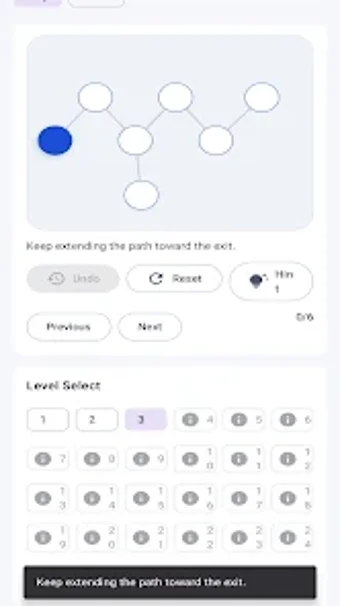
The app centers on node-network navigation where the player must reach a designated exit from a fixed entrance. Levels present different node layouts and explicit rule sets that change permitted movements, so the core loop is planning a route under evolving constraints. The progression is level-based, with each stage increasing complexity to test logical planning rather than time-based reflexes.
How do levels change the way you play?
Each stage supplies a unique movement rule that alters permitted moves through the lattice, which makes memorizing a single tactic ineffective. Players adapt by re-evaluating path options and anticipating how a rule will interact with a specific node layout. That design keeps puzzles from repeating the same mechanic across multiple levels and raises the cognitive demand as layouts and rules compound.
What does the game look and sound like?
The interface is minimalist and distraction-free, focused on clear node networks and readable start/exit markers. The APK size sits at about 6.28 MB, reflecting a pared-back presentation that prioritizes logic over visual flourish. The source notes a lightweight footprint and no emphasis on audiovisual spectacle, so the experience relies on puzzle design rather than high-end graphics or orchestral soundtracks.
Is it hard to get started and how does difficulty progress?
Onboarding is direct: players face concrete node puzzles and the rule text for each level, so learning comes through small, staged challenges. Difficulty scales by combining more complex layouts with novel rule interactions rather than hiding mechanics behind menus. That approach rewards deliberate reasoning but can demand rapid mental model shifts as levels introduce fresh movement rules.
In summary, LatticeDrift suits patient puzzle solvers who like compact challenges
LatticeDrift favors players who enjoy adapting strategies to changing constraints and who value concise sessions on low-storage devices. Players seeking audio-visual richness or social modes may find the minimal presentation limiting. For logical planners who want portable, focused puzzles that change their rules rather than their visuals, the app offers satisfying, thought-driven levels.